EV towing · measured
Does towing reduce EV range? We measured it, empty against loaded.
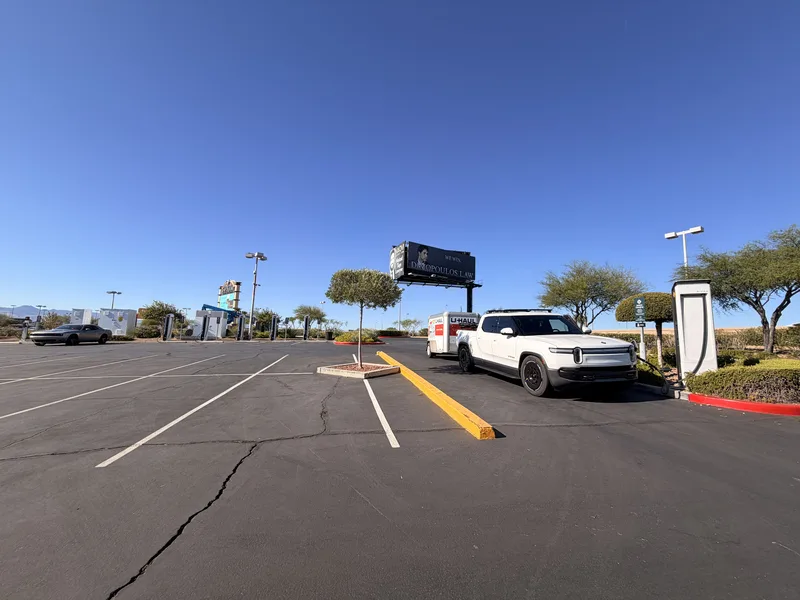
The short answer is yes, a lot, and mostly because of air, not weight. We drove a Rivian R1T empty up Interstate 15 to Utah, then towed a motorcycle home in a rented U-Haul 5x8 on the same road, logging every leg charge to charge. The empty truck held about 2 mi/kWh. Towing the little enclosed box it fell to 1.57 mi/kWh, roughly a 21 percent drop.
Put your own numbers in the EV towing range calculator, see it across trucks in the EV truck comparison, or read the full empty-vs-towed trip.
What the range actually did
On a 141 kWh usable Max Pack, 1.57 mi/kWh works out to about 221 miles of towing range on a full charge, against roughly 282 miles empty. By leg it ranged from 1.45 mi/kWh grinding up over Mountain Pass in the heat to 1.70 on the long, cool descent to the coast, where regen paid some of it back. Averaged across about 757 towed miles it landed at 1.57.
It is drag, not weight
Here is the part people get wrong. The U-Haul plus the motorcycle weighed only about 1,400 pounds loaded (a ~1,000-pound empty trailer plus the ~400-pound bike), a fifth of a typical travel trailer, yet it still gave up nearly a fifth of the range. The reason is that a flat-fronted enclosed box has a large frontal area and pushes a lot of air. The Rivian’s own towing screen even guessed the trailer at 2,500 pounds, nearly double the truth, because it infers weight from motor effort and the drag reads back as pounds that are not there. Light does not mean low-drag.
Speed is the other half of the answer
Aerodynamic drag energy climbs with the square of speed, and the power to fight it with the cube. That makes speed a bigger lever than most drivers realize. The same U-Haul rig, by the model calibrated to our two measured points, ranges like this on a full charge:
| Speed | Towing mi/kWh | Full-pack range |
|---|---|---|
| 55 mph | 1.70 | 240 mi |
| 60 mph | 1.55 | 218 mi |
| 65 mph | 1.41 | 199 mi |
| 70 mph | 1.28 | 181 mi |
| 75 mph | 1.17 | 165 mi |
| 80 mph | 1.07 | 150 mi |
That is why the honest headline is a curve, not a number. And it is a caution when reading any single towing figure, including ours: our towed legs were driven a careful 55 to 65 mph while the empty baseline ran 75 to 85, so speed-matched the trailer’s true penalty is larger, closer to 42 to 47 percent than the raw 25 percent the fast-empty-versus-slow-towed gap suggests.
So how far can you tow?
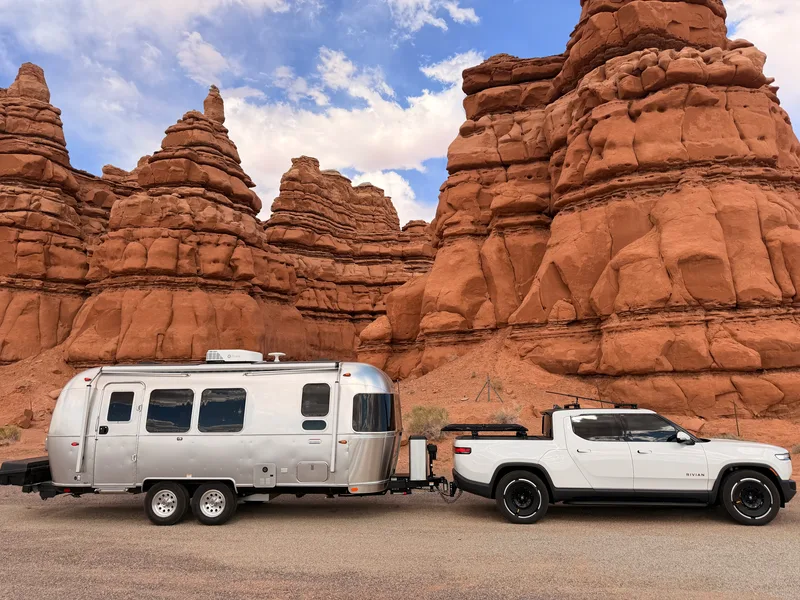
For this light enclosed trailer on a Rivian R1T, plan on roughly 221 miles between full charges at a relaxed pace, less at highway speed, and less again with a bigger, taller trailer. A 23-foot Airstream behind the same truck tows lower still. The calculator lets you dial in the trailer, speed, and battery to get a planning number for your own rig.
FAQ
Towing and EV range, answered
The measured answer to how much towing costs an electric truck.
How much does towing reduce an EV truck’s range?
In our measured data, a Rivian R1T that held about 2 mi/kWh empty dropped to 1.57 mi/kWh towing a light enclosed U-Haul 5x8, roughly a 21 percent hit. On a 141 kWh usable pack that is about 221 miles of towing range versus roughly 282 empty. A heavier, taller trailer like a travel trailer cuts it further.
Is the towing range loss about weight or aerodynamics?
Mostly aerodynamics. The U-Haul 5x8 plus the motorcycle weighed only about 1,400 pounds loaded, a ~1,000-pound empty trailer plus a ~400-pound bike, a fraction of a travel trailer, yet it still gave up nearly a fifth of the range, because a flat-fronted box pushes a lot of air. The Rivian’s own towing screen even estimated the trailer at 2,500 pounds, nearly double the real weight, because it infers weight from how hard the motors work and the box’s drag reads back as phantom pounds.
Does driving slower really help that much when towing an EV?
Yes, more than most people expect. Aerodynamic drag energy climbs with the square of speed, so the same U-Haul rig ranges from about 240 miles at 55 mph down to about 150 at 80. Slowing from 80 to 60 cuts the aero part of the energy budget by about 44 percent. That is why loaded EV towers naturally slow down.
Why is a real empty-versus-towed EV comparison so rare?
Because it needs the same truck, the same route, and both runs measured charge to charge. We drove a Rivian R1T empty up Interstate 15 to Utah, then towed a Ducati home in a rented U-Haul on the same corridor, logging miles, kWh, wind, temperature, and elevation on every leg. That controlled setup is what lets us separate the trailer’s cost from everything else.
EV towing library
More EV towing stories
Field reports, truck comparisons, and the measured data, all in one place.
-
-
-
-

-
-