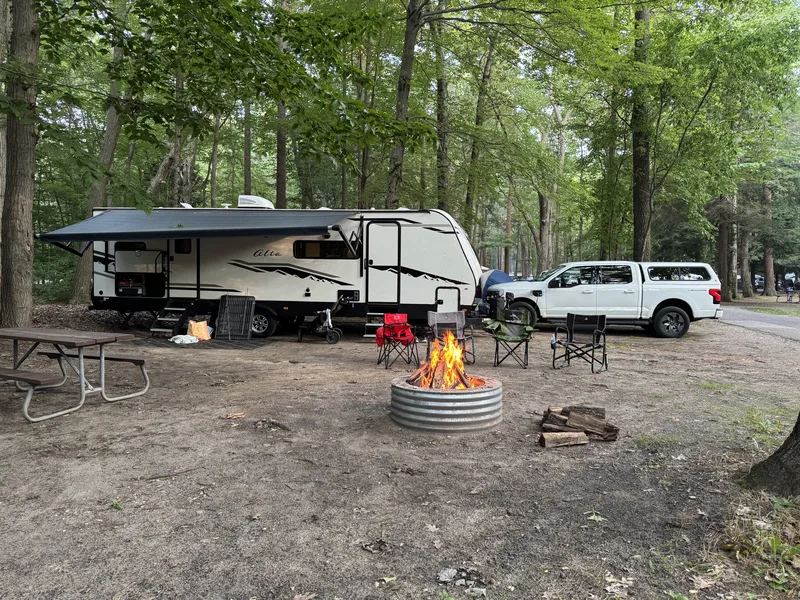
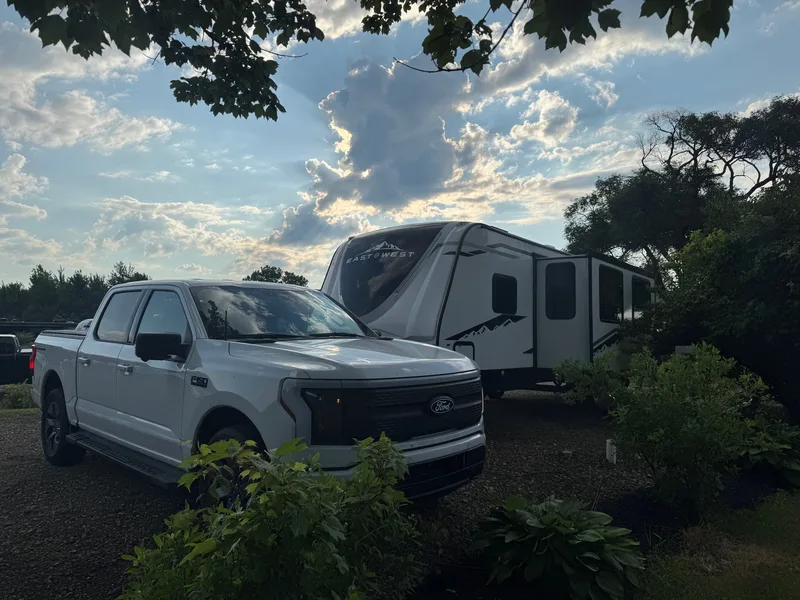
EV Towing, North America, 2026
We towed an Airstream 6,000 miles on electrons. Here is the honest report.
San Diego to Chicago and home again, a 23-foot Airstream behind a Rivian R1T, on electricity alone. Is it doable? What does it actually cost against diesel? Would we do it again? And who is EV towing really ready for today?
- 6,244 miles measured by the truck, San Diego loop
- 4,842 kWh energy used over 31 days
- 1.29 mi/kWh whole-trip average
- 140,340 ft total elevation climbed
- 71 charging stops ~56 fast-charges, 15 free overnight
- $788 to charge free on the Rivian referral; about $1,900 at full list price

The short answer
Is EV towing doable?
The trip is the answer. We did it, with a dog aboard, in 110-degree desert heat and over the Continental Divide, and we were never once actually stranded.
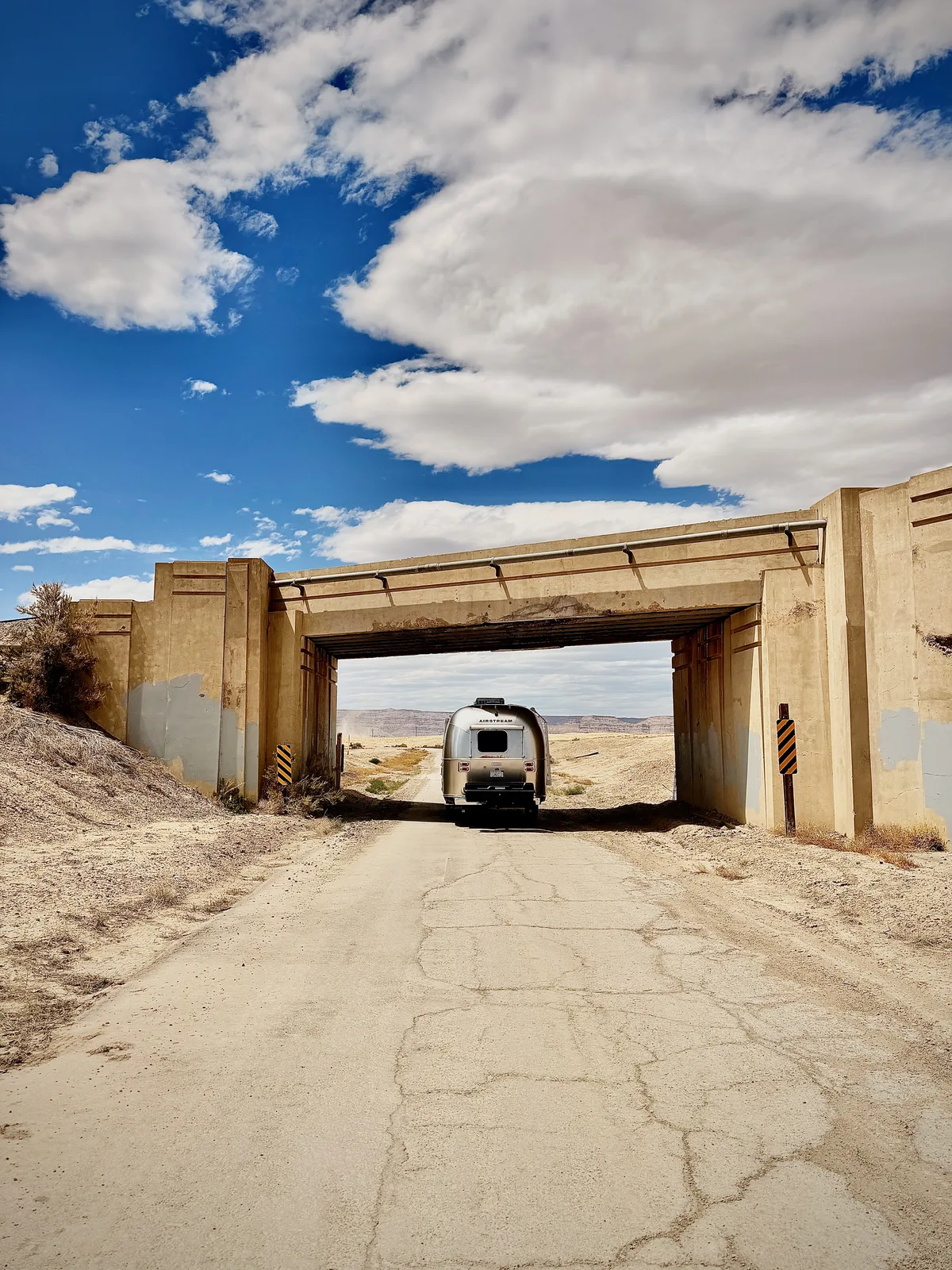
Across the entire loop there was exactly one charger that simply had to work or we were in trouble. One. Every other leg of 44 logged tow segments had an easy backup within range: a second network, a slower stall, a campground pedestal, a place to sit and wait. The safety net was almost always there. EV towing in 2026 is not an experiment you survive. It is a road trip you plan.
The honest planning number is not the marketing range. Towing the Airstream, our real full-pack range worked out to about 168 miles, and the number we actually planned around was a 100 to 120 mile hop between charges. Treat the gaps between fast chargers as the constraint and the whole thing relaxes.
- 4,405 tow miles measured under the trailer
- 1.19 mi/kWh weighted towing average
- ~40 MPGe energy-equivalent fuel economy, towing
- 168 mi real full-pack towing range

The road, honestly
What the charging actually felt like
The number that defines an EV road trip is not range. It is time plugged in.
We made roughly 56 fast-charge stops on the road, plus 15 free overnight campground charges, and spent 35 hours and 27 minutes connected to DC fast chargers over the trip. That is about 38 minutes a stop, on average, and it is the real tax of doing this in 2026. A diesel pulls into a pump and is gone in five minutes (actual stop time is usually closer to 10 or 15 minutes once you count the walk in, the restroom, grabbing a drink, the line, and the receipt, but the diesel folks never want to admit that). We were not.
Thirty-five hours sounds horrifying until you spread it across a month on the road. It works out to about an hour a day, across fewer than two charging stops a day. Each roughly 38-minute stop bought us about 113 miles, two and a half hours of driving, so all that charging supported nearly 130 hours behind the wheel. Put another way, for every hour we drove, we charged about 15 minutes. A normal travel day was two stops and an hour, and even our heaviest days each carried their own story. Our two 500-mile crossings came back to back on the way home, 582 miles one day and 523 the next, ripping out of the Chicago area across Iowa, Missouri, and Kansas to beat the clock to Colorado, including one 229-mile pull from Hays, Kansas up onto the Colorado high plains, six fast-charge stops and roughly five hours of charging each. We pushed to reach Denver a day early and breathe before Rocky Mountain National Park, and we did. The hardest stretch of all came at the very start: the dash from San Diego across to Oklahoma to collect my wife from the airport. I would have left sooner, but my son was graduating college and I was not about to miss that, so I hauled, and still stole the time to drop down onto Route 66 and take the country roads. Even the long days got us where we needed to be, on time, on electrons.
- ~1.1h/dayaverage time charging, spread over the trip
- 1.7stops/dayfewer than two on a normal day
- 113miaverage distance between charges
- 26%of drive time~15 min charging per hour driven
And here is the part that only makes sense when your bed is bolted to your truck: some of those longest stops, we slept right through. More than once we plugged in for a power nap or for the night and woke up in the Airstream with a full pack, comfortable the entire time, never actually needing it to charge that long. The trailer turns a charging stop's worst case, a long wait, into its best case, a real rest. So the 35-hour figure overstates the waiting; a meaningful chunk of it was sleep we wanted anyway, in a bed we brought with us. And here is the funny thing about the Airstream: once you close the curtains, it is genuinely hard to tell whether you are parked at a Rivian charger in a shopping-center lot or deep in a national park. Inside, it looks just as nice in the parking lot as it does under the pines.
You learn to live inside the charging curve. Towing, you arrive at a stall low, which is actually the good news: the pack takes power fastest when it is nearly empty, so the first ten or fifteen minutes fly and then it tapers. The move is to charge in the fat part of that curve, roughly the 10 to 60% window, get your 100-mile hop back, and go. Chasing the last 20% on the road is a waste of your life. The Rivian's peak charging speed is barely acceptable in 2026, nowhere near class-leading, and on a trip this size you feel every kilowatt it leaves on the table. It is an area Rivian's engineers really need to attack for the next generation, and the US charging infrastructure is not even close to matching how fast China is advancing.
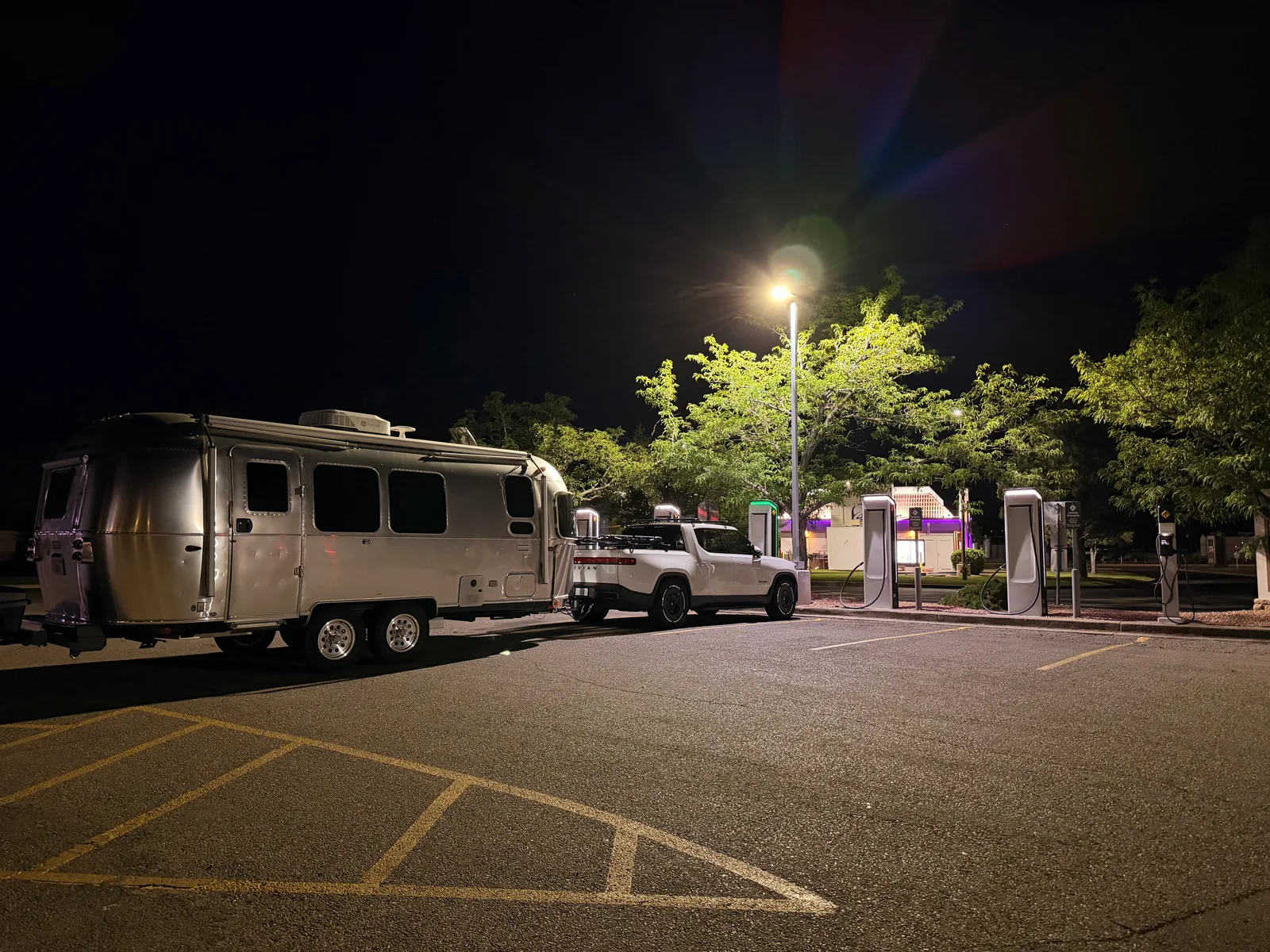
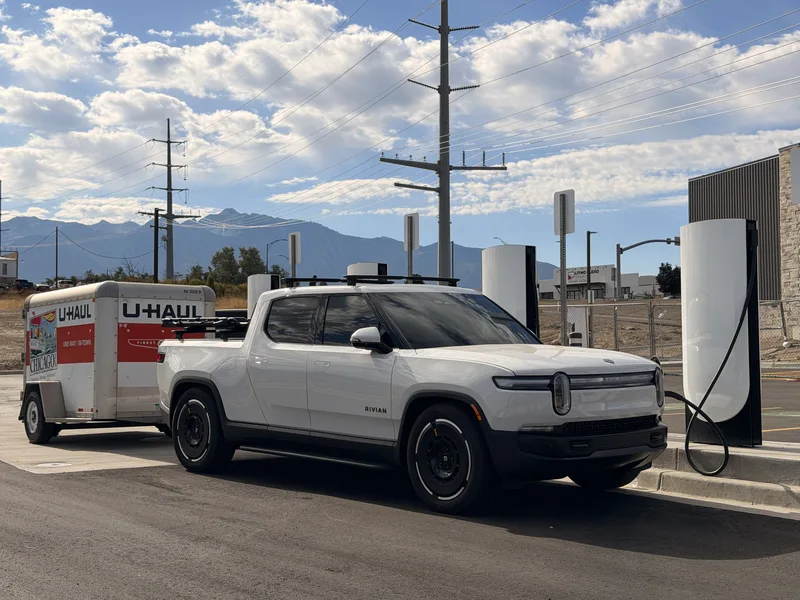
That photo is the argument in one frame. We pulled into a charger and plugged in without unhitching, almost every single time, because the Rivian's charge port is on the front. On the entire trip we had to unhitch to charge exactly once, at the Rivian Adventure Network site at the Camelback Esplanade in Phoenix, where the stalls sit inside a parking structure with no room to maneuver a 47-foot rig. We dropped the Airstream, charged, and re-hitched, the one exception that proves the rule. It is also the easiest fix in the world: a single trailer-friendly pull-through stall there would solve it outright, and here is hoping Rivian adds one. Hold that thought, it comes back when we talk about the other trucks.
The upside
Where EV towing already wins
Reliability. It is not close.
Over 6,000 miles and we did not have a single mechanical issue. No diesel exhaust fluid. No oil changes. I barely touched the brake pedal the whole trip, because regen braking holds the rig on grades that would cook conventional brakes, including the long drop off the Continental Divide. The Rivian is not zero-maintenance, it asks for a tire rotation every 7,500 miles or so, but those are free where we bought the tires, and next to oil, DEF, and fuel filters it is barely a list. The only part we bought for the truck on the entire trip was a five-dollar bottle of washer fluid.
And where diesel pickups were laboring up the big climbs, we had more power than we needed. Horsepower and torque make all the difference with 6,000 pounds behind you. We climbed 140,340 feet of cumulative elevation and the motors never strained. The third win is efficiency: even loaded and fighting heat, the Rivian returned 1.19 mi/kWh weighted across all 44 tow segments, the best of any truck we would seriously consider. Put that in the units a gas or diesel driver actually thinks in: the EPA counts 33.7 kWh as one gallon of gasoline, so 1.19 mi/kWh works out to about 40 MPGe, miles per gallon equivalent. Towing 6,000 pounds across the desert in triple-digit heat, we ran the energy equivalent of a 40-mpg economy car, while a diesel F-250 doing this same work returns about 12 mpg and a gas one about 10. Same job, a third of the energy. Which brings us to the bill.
The number that ends the diesel argument
Let us be precise about charging, three honest ways. We paid $788 because most of our charging was free on the Rivian Adventure Network referral. Take the perk away and the same route at Rivian's list price runs about $1,900, but that is a high ceiling, not a likely bill, because Rivian's network is on the pricey end and we used it precisely because it was free. Optimize for cost instead, charging on cheaper Tesla and IONNA stalls at around $0.37 a kilowatt-hour, and it lands near $1,543.
Every one of those beats a diesel's roughly $2,710 in fuel and a gas truck's $2,570. Pick whichever scenario you think is fair: electric still wins, and the inflated list price is the only one that even comes close.
| Over ~6,244 miles | Our Rivian | F-250 diesel | F-250 gas |
|---|---|---|---|
| Energy / fuel cost | $788 | ~$2,710 | ~$2,570 |
| Cost per mile | 13¢ | 43¢ | 41¢ |
| Tailpipe CO2 | 0 lb | ~11,700 lb | ~12,500 lb |
| Oil + DEF service | $0 | ~$250 | ~$100 |
| Transmission flush (prorated) | $0 | ~$85 | ~$85 |
| Brakes (prorated) | ~$0 | ~$150 | ~$150 |
| Tires + washer fluid | ~$5 | ~$5 | ~$5 |
| Maintenance, this trip’s share | ~$5 | ~$490 | ~$340 |
| Time refueling | 35h 27m | minutes | minutes |
Diesel assumes 12 mpg, gas 10 mpg towing this 6,000-pound load, at June 2026 US average prices ($5.21 diesel, $4.11 gas), with EPA tailpipe figures. Maintenance uses a Ford F-250 reference: oil and DEF are the service these miles actually trigger; transmission and brakes are the prorated share of services that come due every 30,000-plus miles, weighted here for the 140,340 feet of descent a combustion truck rides its brakes down and the EV takes on regen. Figures are approximate; the direction is not.
And the routine stuff is not even where towing really bites. Hauling 6,000 pounds accelerates the expensive services, the ones the EV simply does not have. An F-250's ten-speed transmission wants a fluid flush far sooner when it tows, real-world advice runs every 30,000 to 60,000 miles instead of the 150,000 on paper, and that service is $450 to $680 because the box holds over 17 quarts. The Rivian has no transmission to flush. Towing also eats brakes, a diesel riding them down a grade can need a pad-and-rotor job at several hundred dollars an axle, and often. On the Rivian regen does that braking, so our pads and rotors are effectively still new and the only brake item on the truck is a fluid flush every three years. The harder you tow, the more lopsided the maintenance math gets.
The honest counterweight is time. That same 35 hours and 27 minutes of charging is time a diesel spends driving. You are trading dollars and emissions for hours. On a 6,000-mile haul, that trade was real. On a 250-mile weekend, it would barely register, which turns out to be the whole point of who this is for.

Colorado
Over the Divide, and at home in Denver
If one stretch sold me on this truck for this life, it was Colorado.
The Rivian's Tri-Motor Max Pack makes around 850 horsepower, and you feel every bit of it the moment the road tilts up. We towed the Airstream over the Continental Divide through the Eisenhower-Johnson Tunnel at 11,158 feet, the highest interstate tunnel in the world, and the truck never strained or hunted for a gear, because there are no gears. It just climbed, quiet and flat on the torque, while the diesels around us downshifted and roared. Coming down the far side, regen did the braking. With 6,000 pounds behind you, that much power stops being a number and becomes confidence.
What surprised me more was the other half of Colorado: the city. This is where the Rivian quietly wins an argument the spec sheets never have. A Ford F-250 or a GMC 2500 has the towing brawn, but park one downtown and it becomes a barge, too long and too wide, a chore in every garage and on every side street. The Rivian is right-sized. It threads urban Denver as deftly as it crawls a mountain pass with the trailer on. One truck that is genuinely at home both in RiNo traffic and over the Rockies is rarer than it sounds, and it is exactly what a trip like this needs.


We made two basecamps here and loved both. First Lyons, tucked against the red-rock foothills north of Boulder, then Clear Creek RV Park down in Golden, the mountains right there and a creek you can float a tube down on a hot afternoon. Both towns were the genuinely welcoming kind, the sort of place you catch yourself checking real-estate prices on your phone.
Denver was on the map for the people. We met up with Patrick and Liv of the Electric Duo, EV-touring friends who showed us their city: a rooftop burlesque show with the downtown skyline lit behind the stage, and a big reason we pushed to roll in early, the fifty-plus-member electronic-percussion spectacle ITCHY-O at Mission Ballroom. A great meetup with other EV friends, the kind the charging life keeps handing you.
Somehow Colorado turned into one of our favorite stretches of the whole trip. Between the mountains, the towns, and the people, it was genuinely hard to hitch up and leave.
The real audience
Who EV towing is actually for
Here is the thing nobody building these trucks seems to say out loud: most people don't take a trip like ours.
Most people buy a camper and camp within a couple hundred miles of home. That is not a guess, it is the industry. About 40% of North American campers travel fewer than 50 miles from home on a typical trip, up from 13% in 2014 and 31% in 2018, a clear and growing trend toward close-to-home camping. The median camping trip is about 250 miles. The average RV owner drives roughly 4,500 miles a year in their camper, across every trip combined.

Sit with that last one: this single trip, nearly 6,000 miles, covered more ground than a typical RV owner puts on their camper in an entire year.
Which flips the whole question. EV towing could be a fantastic solution for a huge number of families and retired couples who travel a couple hundred miles, camp for a week, and want a tow vehicle that can also power the camper off the grid. For that buyer, the range anxiety that dominates every comparison review basically evaporates, and the time-at-the-charger tax nearly disappears with it. I would go so far as to say EV towing fits far more people than would ever currently consider it. The trucks are being judged against trips almost nobody takes.
The point of it all
What the chargers gave back
Good infrastructure does one thing above all: it disappears.

Once routing stopped being the scary part, the trip stopped being about the truck and went back to being about the road. We saw the Mighty Five, every one of Utah's national parks, Zion, Bryce, Capitol Reef, Canyonlands, and Arches, without ever once sweating the next charge. A couple of years ago that itinerary on electrons would have been a stunt. This year it was just the plan.
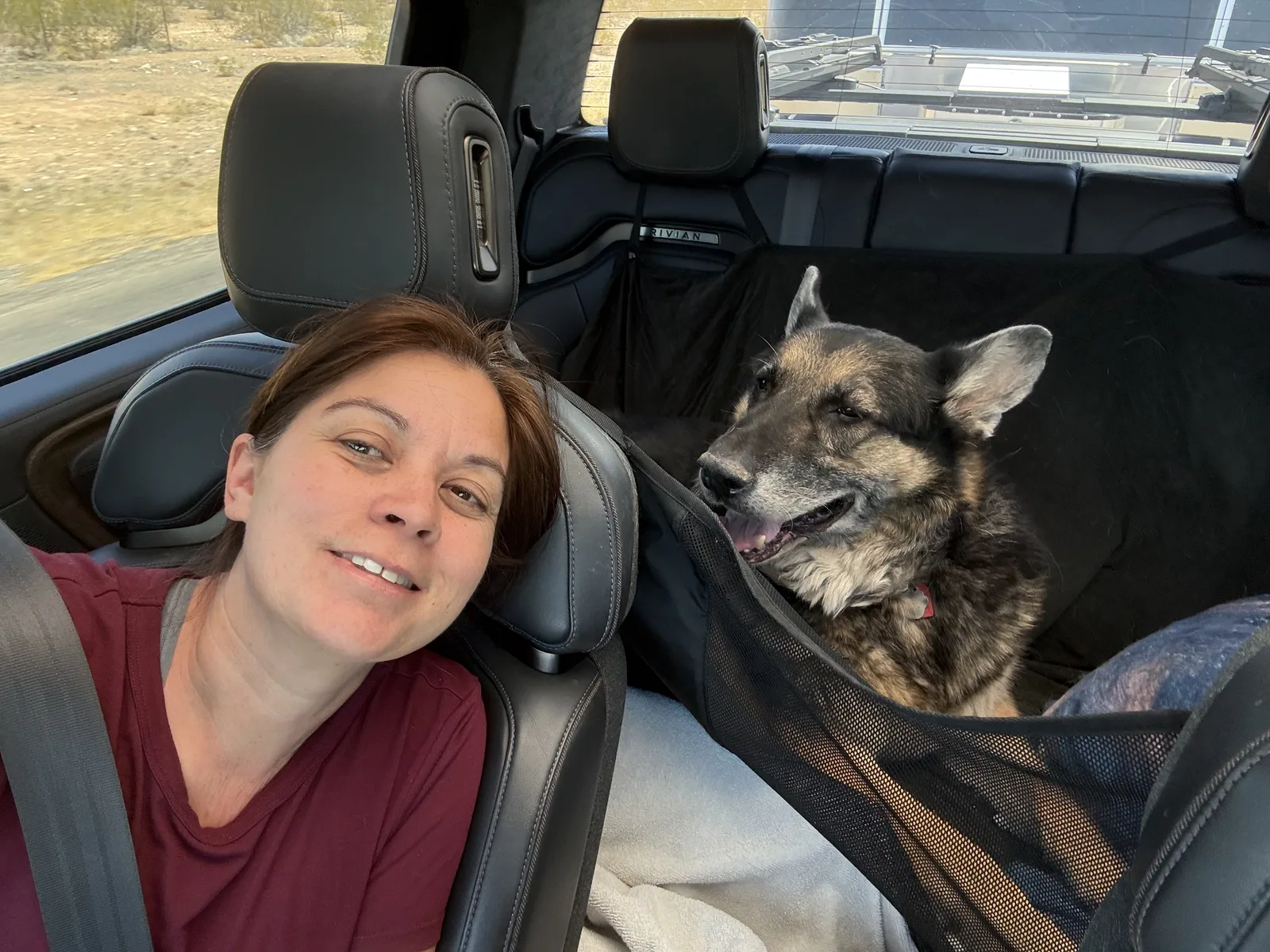
Keeping him safe in the heat is where one more piece of the rig paid for itself. Starlink gave us real internet at the Airstream no matter how far off the grid we parked, so we could watch the trailer's temperature from a phone and check on Mission while we were out hiking or sitting at a charger, and drop the air conditioning a few degrees from the trailhead when the Mojave decided to climb. For an eleven-year-old shepherd on a 113-degree afternoon, knowing the inside of the trailer to the degree from a mile away was not a luxury. It was the difference between leaving him comfortable and not leaving him.
And then there was the part that actually matters. EV-towing friends drove in from a long way off just to hang out with us in Branson. We stayed with my cousins at their farmhouse. We saw my father and my daughter outside Chicago, and tracked down friends I have known since childhood. We ate ridiculously well the whole way, and the dog rode shotgun for all of it. The charging network did not just make the trip possible. It got out of the way so the trip could be about everyone we love and everywhere we have been meaning to go.
On the road
What surprised us

The infrastructure is better than we expected
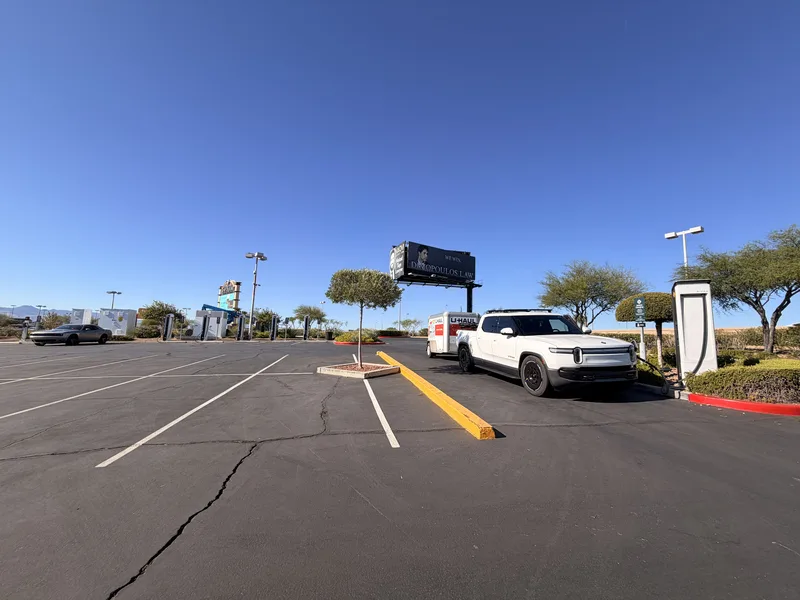
We braced for a charging desert and found a network. There were far more chargers than we expected, and routing was genuinely easy. We could take almost any route we wanted. A couple of years ago that was not true. The Tesla Supercharger network opening to non-Teslas, plus newcomers like IONNA, turned navigation from the scary part of the trip into an afterthought. Credit where it is due: Rivian has made trailer pull-through stalls a real priority at its Adventure Network sites, so we could roll in fully rigged and charge without a circus.
And the network is visibly improving in real time. The three fastest charges of the entire trip were the last three, all on the drive home, and all at newer or recently upgraded Rivian Adventure Network sites: Barstow at 211 kW, then San Bernardino and Temecula both a hair over 215. Same truck, same week, but the shiny new chargers fed it noticeably harder than the older ones did earlier in the trip. The infrastructure that scared us two years ago is being built and upgraded faster than the trucks plugged into it are getting better. Which makes it all the stranger, as you will see, that the truck itself still gets two basic things wrong.
Everyone wanted to talk
Almost every campground we rolled into, someone wanted to talk about the setup. We were packing up to leave Ruby's Inn when a farmer from West Virginia, coal country, a robust country boy, came over to talk about towing with the Rivian. I was shocked at how pro-EV he was.
He told me about his grandfather, who bought one of the first Priuses, then bought every generation after and sold them cheap to the kids as they grew up. They all got hooked. On his farm and his construction jobs, his workers are red-blooded Americans who think diesel is somehow more American. He tells them: we mine coal here, and electric vehicles use that electricity more efficiently, with less carbon than diesel. That, he tells them, is more American.
A conversation outside Ruby's Inn we couldn't stop having
We really did need to pack up. I just kept talking with him. If that was you, outside Ruby's Inn, find us. I owe you the rest of that conversation.
Wind matters more than the mountains
We expected elevation to dominate efficiency. It does play a role. But wind speed and direction turned out to be a bigger factor than we ever expected, and the data is stark. Across the trip, the swing from a tailwind to a headwind moved our range by 42 miles, a 27% efficiency change. The swing from flat ground to a net climb moved it 24 miles, 16%. Heat moved it 32 miles. The wind, not the grade, was the thing that most often decided whether a leg was comfortable or tight.
You can watch it happen leg by leg. Our biggest tailwind, a 25 mph shove from Albuquerque to Tucumcari, carried us 176 miles at 1.66 mi/kWh. A 26 mph headwind on the Green River to Torrey grind dragged the same rig down to 0.92 over 108 miles, nearly double the energy per mile in the same week. And the single best leg of the whole trip stacked both gifts at once, 110 miles dropping off the Bryce plateau toward Zion with a tailwind behind us, 1.88 mi/kWh.
The big question
So, would I do it again?

With this generation of trucks and this generation of charging speeds in the United States, no. And it took 6,000 miles to be able to say that with a straight face.
This is not a knock on the trip, it is an honest read on the hardware. There is no perfect EV truck for long-distance towing right now, especially for a real trailer like our Airstream. Every one of them gets something genuinely right and something genuinely wrong, and on a trip this size the wrong things compound. I do not want to turn this into a spec-sheet shootout, so here is the short version of what each one nails and misses.
GMC Sierra Denali EV / Chevy Silverado EV (Max Pack)
Right: range and charging speed. Wrong: the inverter, the port, and the software.
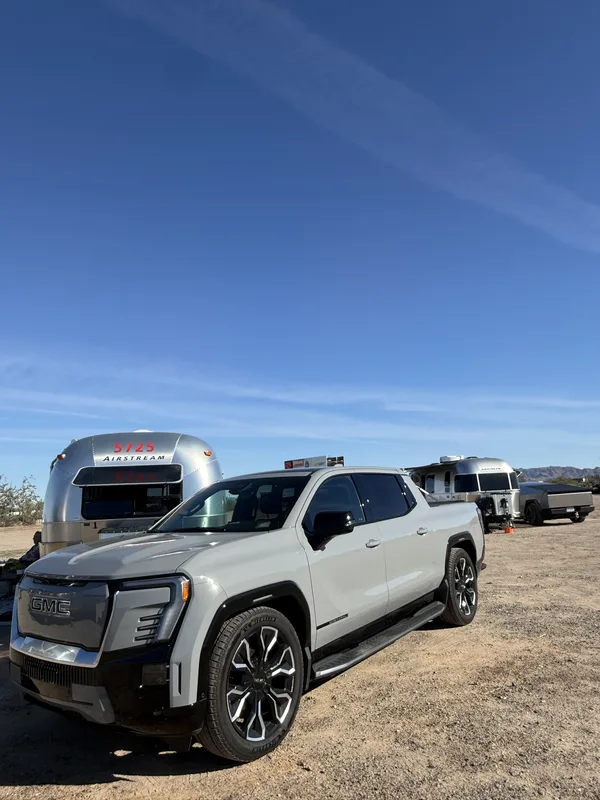
The Max Pack has the range we wish we had. So much of our overnight campground charging was free, and the Rivian would sit full for hours before we were ready to roll, all that energy wasted. A bigger pack banks it. We figure the Silverado or Denali would have eliminated 25 to 30% of our charging stops, and on the 800-volt Ultium architecture they charge genuinely fast when they do stop. But the wins stop at the hardware. In our assessment its inverter is the weak link, it does not feel stout, does not match the older Ford Lightning's Pro Power Onboard, and falls down under load. Its charge-port location means far more unhitching to charge than the Rivian, a real chore with a weight-distribution hitch. And the software is the letdown, especially since GM dropped Apple CarPlay for its own built-in system: the range and the charge speed are both great, but the tech falls short.
Tesla Cybertruck
Right: software, manners, the inverter. Wrong: range and the rear port.
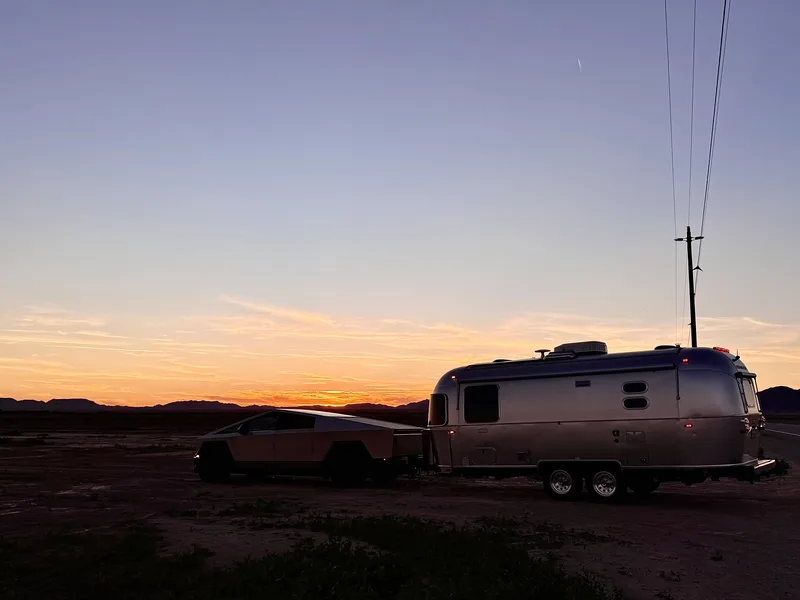
The Cybertruck is the one that can power the camper. Its inverter can run the trailer even while the truck is charging, which is exactly the feature that would have let us sleep in the national parks that have no hookups. But its towing range is the shortest of the three, roughly 140 miles to our Rivian's 168. We ran the math: the same trip in a Cybertruck means about 20% more charging stops, and its rear charge port forces an unhitch at most of them with our hitch. It would have powered more campsites and made every charge a bigger chore. The best-driving truck here would have made this particular trip more painful, not less.
Rivian R1T Tri-Motor Max Pack our truck
Right: the whole package. Wrong: the inverter and the last 30 miles of range.
I still believe the Rivian is the best tool on the market for this job. The front charge port let us charge while hitched on all but one stop the entire trip. The gear tunnel, the built-in air compressor, the powered tonneau, the genuinely good software, and the best towing efficiency of the bunch all earn their keep. What holds it back is maddening precisely because Rivian so clearly understands towing: this is the company that prioritizes trailer pull-through stalls at its chargers, and yet ships a DC-to-AC inverter too weak to run the Airstream and a Max Pack that is a touch short on range. A real inverter and another thirty miles, and there would be no argument.
The feature that would change everything
Pull those threads together and one missing feature explains most of our frustration: a truck that can power the camper. The promise that sold us on an electric truck was tow your house, then power your house, a silent generator at your campsite, no propane, no fumes, no fifty-dollar-a-night powered pull-through. With a real 240-volt inverter we would have stayed in many more of the national parks that offer no hookups at all. Today the Cybertruck is essentially the only truck that can do it, and choosing it means accepting 20% more charging stops and an unhitch at most of them. Nobody sells the whole thing in one package yet. The first one that does, a real inverter, a true Max Pack, and a front charge port, changes this entire calculation.
And here is what worries me as a Rivian owner and a genuine fan: the company will look at how rarely owners pull serious power off the truck and conclude there is no demand. But the usage is low precisely because the feature barely works. Nobody plans a camping trip around an outlet they cannot trust. Give the R1T a usable inverter, real 240-volt AC at 30 amps or more, and that data flips overnight, because the truck can finally run the trailer and people will actually use it. A little more range, a slightly faster charging curve, and a real inverter are the entire list. That is the whole gap between a good EV and an incredible EV work-and-camp truck.
What would actually change my answer
Not much, honestly. Give me another hundred miles of towing range and charging even half as fast as the new Chinese EVs already manage, plus an inverter that can run the trailer, and this goes from a trip you plan carefully to a trip you just take. The reliability is already there. The power is already there. The efficiency is already best-in-class. The missing pieces are range, charge speed, and camper power, and all three are engineering problems on a clear curve, not fundamental flaws. Ask us again in two truck generations.
The receipts
6,244 miles. 71 charging stops, about 56 of them fast-charges on the road. 35 hours and 27 minutes plugged in. $788 out of pocket, and $1,111 of free charging on the Rivian Adventure Network. One washer-fluid bottle. Zero breakdowns. Zero tailpipe. Every number is downloadable, and the per-segment math is on the tow-segment pages.
Who's behind the data
Meet the crew
We are not journalists on a one-week press loan. This is the rig we actually live with, and EVs are not new to us. As a family we have driven electric since 2015, starting with compliance-era cars like the Volkswagen e-Golf, the Fiat 500e, and the Ford Focus Electric, then a string of Teslas including a Plaid track car, and now several Rivians. Every car we own has been electric since 2019. So when we say the inverter is too weak or the range is thirty miles short, that is ten years of living with these things talking.
Eric
A lifelong car and motorcycle enthusiast who has owned everything from 911 Turbos to exotic Ducatis, and still keeps a small motorcycle collection. Car and motorcycle culture is the through-line; the Airstream is just the newest excuse to chase a good road.
Diana, "Lucy"
A registered sleep technologist at the hospital, where she helps people manage sleep apnea and conditions like narcolepsy. She is close to her big family and loves traveling with the Airstream community and her EV friends, a crew that camps together and drives electric to a different national park every year.
Mission
An almost-eleven-year-old German Shepherd who rode every mile from the back seat. He hit a rough patch of illness on this trip but is doing well on his medication, and he is not letting it slow the adventures down.