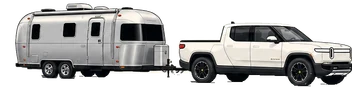
Rivian R1T Tri-Max
Three motors. 850 horsepower. 420 miles of range on a good day, and closer to 180 with a 6,000‑pound Airstream in tow. Range, elevation, wind, and charger layout become part of the adventure.
See the truckField notes and measured EV towing data from a cross-country road trip pulling a 23-foot Airstream behind a Rivian R1T Tri-Max. San Diego to Chicago and back, on electrons alone.

Charging an EV across the American West and back through Utah and Colorado. Out and home, on electrons alone.
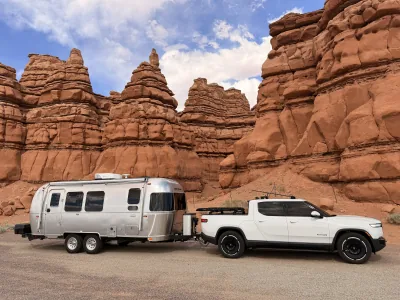
Day 27 · Tuesday, Jun 9

Day 28 · Wednesday, Jun 10

Day 29 · Thursday, Jun 11

Day 30 · Friday, Jun 12
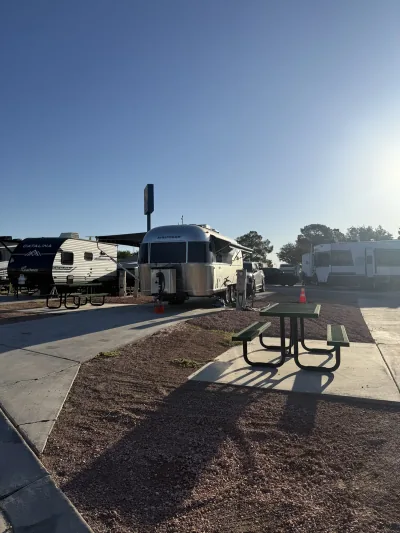
Day 31 · Saturday, Jun 13
+ 26 more days
Three motors. 850 horsepower. 420 miles of range on a good day, and closer to 180 with a 6,000‑pound Airstream in tow. Range, elevation, wind, and charger layout become part of the adventure.
See the truckPolished aluminum, panoramic windows, and a small enough footprint to fit in most state-park sites. Our rolling basecamp from desert washboard to Great Lakes shoreline.
See the AirstreamSixteen-ish states. Charge stops mapped, campsites booked, scenic detours welcomed. We're documenting every kilowatt-hour, every campsite, and every route choice the map helps us make.
Follow the routeThe work product
The trip is the story. The dataset is what it leaves behind: real charge-to-charge towing numbers, logged off the dashboard, turned into tools anyone can use.
Compare Rivian, Cybertruck, Silverado EV, Sierra EV, and custom usable kWh packs against our measured Airstream efficiency.
175 mi full-pack estimate Study real dataOpen the rig-wide dataset, the efficiency breakdown, the segment ledger, and the CSV/JSON exports built for citation.
1.24 mi/kWh weighted average Read the field testFirst-hand Arizona Airstream notes on Cybertruck ride, range, charging layout, inverter power, headlights, and how it stacks up against the Rivian.
140 mi Cybertruck tow estimate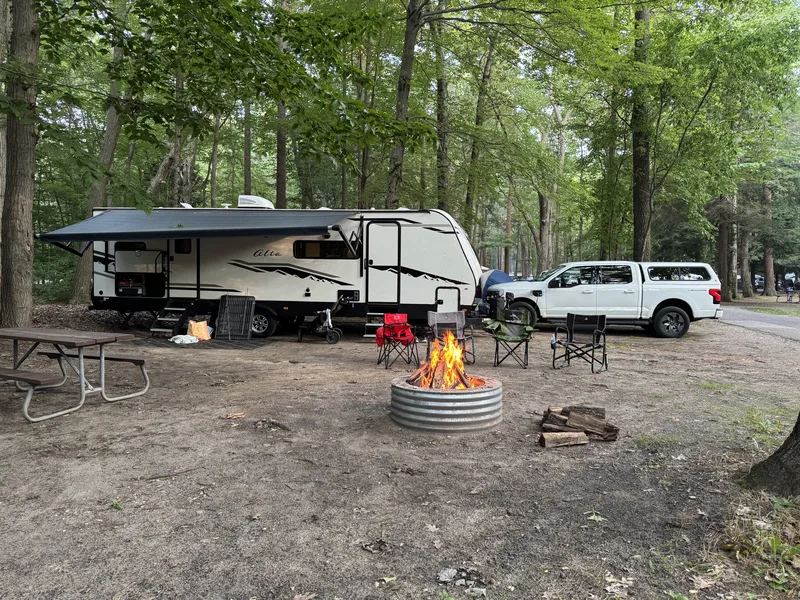
The other side of the driveway: EV-towing creator TesCalendar pulls a 32-foot camper with a 2024 F-150 Lightning Flash. Field reports from cross-country miles to a weekend at the lake, plus a photo album from the road.
3 field reports, 31 photosMore EV towing data: EV truck comparison · Rivian R1T towing range · efficiency by condition · the segment ledger · the Rivian R2
Where we slept
23 stays across 10 states, averaging 7.7/10. Every review covers hookups, bathrooms, dogs, what we paid, and whether an EV can charge there.
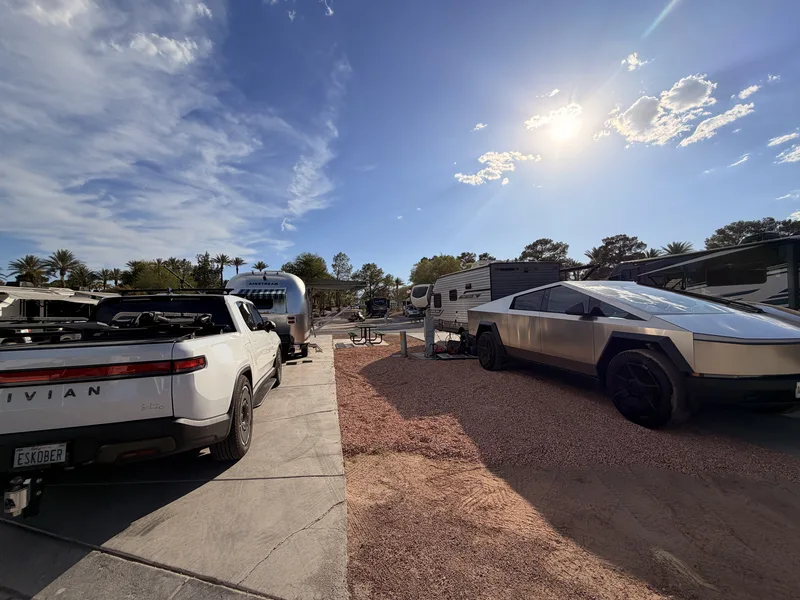 10/10
10/10 Las Vegas, NV
A great base for Vegas at a good price. Clean, well-maintained sites with everything you need: a store, a…
 10/10
10/10 Chula Vista, CA
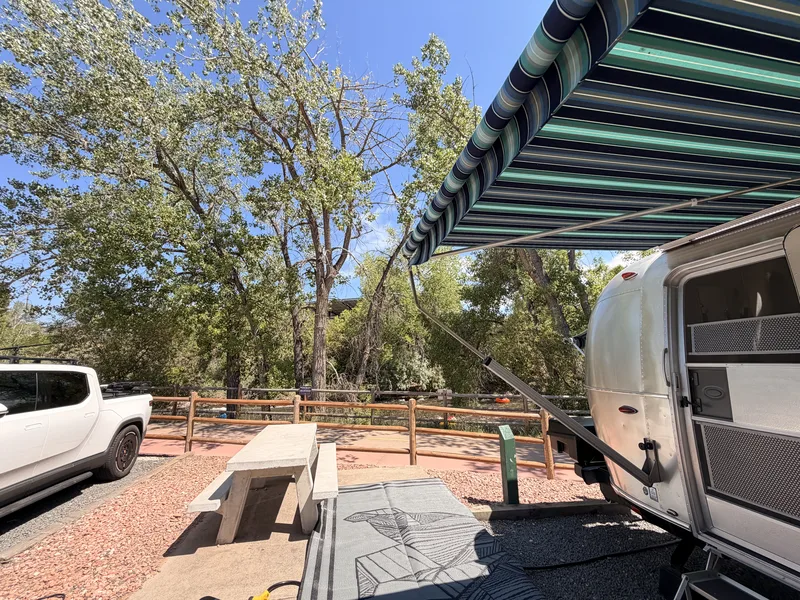 9.5/10
 Golden, CO
All campground reviews EV charging at campgrounds The campground gallery
FAQ
Range, battery life, wind, and wear, straight from the trip logs and our 141 kWh Rivian R1T pulling a 6,000 lb Airstream.
With a 141 kWh usable Rivian R1T Tri-Motor Max-Pack pulling a roughly 6,000 lb 23′ Airstream, we average 1.19 mi/kWh across 4,000+ logged towing miles. On a full pack that is roughly 130 to 265 miles of range depending on conditions: our best 100-plus mile segment hit 1.88 mi/kWh (about 265 miles) behind a 25 mph tailwind and a long descent, while a hard headwind dropped us to 0.92 mi/kWh (about 130 miles). In practice we plan charge stops 100 to 120 miles apart to keep a buffer for wind and grade. A useful rule of thumb: a travel trailer cuts the truck's unladen range by more than half.
On the highway we recharge every 100 to 120 miles while towing, so a charge lasts a little under two hours of driving before the next DC fast-charge stop. Towing the Airstream roughly doubles consumption versus running the truck empty: about 420 miles of range unladen against about 180 towing. Over the life of the pack, Rivian warranties the Max-Pack battery for 8 years or 175,000 miles, and our Gen-2 R1T has already towed 18,000-plus miles with no measurable change in towing range.
In our experience, no. An electric drivetrain has far fewer moving parts than a towing-duty gas or diesel engine: no transmission to overheat on a grade, no oil to cook, no exhaust brake to ride downhill. The R1T uses regenerative braking to hold the trailer back on long descents instead of burning the friction brakes. At roughly 6,000 lb loaded we tow well under the truck's rating, so the motors never labor. After 18,000-plus towing miles the only consumable we watch closely is tires.
More than hills do. Towing a tall, flat-sided aluminum trailer, wind direction is the single biggest variable in our logs. A 25 mph tailwind pushed our best segment to 1.88 mi/kWh; a 25 mph headwind dragged three segments in a row down to 1.0 to 1.14 mi/kWh on flatter ground. The truck itself handles crosswinds beautifully, the truck's own weight and the low, floor-mounted battery keep it planted, but a sustained headwind can erase 30 to 40 percent of your range. We watch the forecast and, when we can, drive the calm early-morning hours.
We favor the Rivian Adventure Network (free on our truck, 200 to 220 kW) and Tesla V4 Superchargers via the NACS adapter (up to 325 kW), with IONNA and Electrify America as backups. A typical tow charge adds 60 to 125 kWh in 20 to 40 minutes, enough to cover the next 100-mile leg with the trailer still attached. We do not unhitch to charge: pull-through stalls or the edge of the lot handle the 23′ Airstream trailer.
Tow vehicle: a 2025 Rivian R1T Tri-Motor Max-Pack, 141 kWh usable, about 850 hp, roughly 420 miles of unladen range. Trailer: a 2024 Airstream International 23FBT, 23 feet, twin-axle, polished aluminum, about 5,000 lb dry and 6,000 lb fully loaded. Those two numbers, 141 kWh of usable battery and about 6,000 lb of trailer, are the baseline behind every range figure on this site.
Charge-stop notes, weather calls, and the small stuff that never makes the photo grid. Instagram and YouTube round it out on the connect page.
See where to follow